
What If “Nothing Happened” During My Ketamine Infusion Therapy Session?

Summary
When people imagine ketamine infusion therapy, they often picture something dramatic: a big emotional release, vivid visuals, deep memories rising to the surface. So when you finish a session and feel... "nothing," it can be confusing. “Did it work? Did something go wrong? Did I miss something?”
You’re not alone. In fact, "nothing happened" experiences are far more common than you might think, and they can be deeply meaningful in ways that aren’t obvious at first.
This article explores the science, psychology, and potential meaning behind quiet sessions in ketamine therapy. If you’ve ever left the treatment room wondering if anything really changed, this is for you.
Want to learn more? Explore our resources for how to get the most out of your ketamine treatment expereience.
What Does "Nothing Happened" Actually Mean?
Many people define it like this: no visuals, no strong emotional shifts, no altered sense of time or body. You may have felt completely lucid and normal throughout the entire session.
It’s natural to think this means it didn’t work. But ketamine, like other psychedelic medicines, often works behind the scenes; in the biology of the brain, in the subconscious, or in ways that don’t show up as fireworks.
Before you decide it fully “didn’t do anything,” let’s break down what may have been happening.
The Brain Is Always Listening
Even if your conscious mind felt unchanged, your brain was still engaged. Ketamine is a powerful agent of neuroplasticity. This means it temporarily increases the brain’s ability to form new connections and release old ones.
This happens whether or not you feel altered. That’s why some describe ketamine infusion therapy as a two-part process:
- Biological: The medicine triggers neural change, often lowering inflammation and quieting hyperactive circuits related to depression, anxiety, or chronic pain.
- Psychological: Sometimes these changes are accompanied by conscious insights, sometimes they aren't.
In short: even if you don’t feel something, something is happening.
Possible Reasons for a "Quiet" Session
1. Your System Needed Rest
Many patients come into treatment burned out, anxious, and over-extended. Sometimes, your body simply uses the session to rest. Instead of deep visuals, you might experience stillness, simply because that’s what your nervous system needs most.
2. The Work Is Subconscious
Not all healing rises to the surface in words or pictures. If you’re carrying trauma, grief, or deep exhaustion, the brain may choose to process in a layer below your conscious awareness, keeping you safe while it lays the groundwork for later breakthroughs.
3. You’re Being Primed for Future Sessions
Ketamine therapy isn’t a one-time event. It’s a cumulative process. A quiet session can act like emotional tilling, preparing the soil for future insights to grow. You may notice deeper responses in later sessions because of groundwork laid in the “quiet” one.
4. Your Expectations May Have Influenced Your Perception
This is common and very human. If you came in expecting a certain kind of session, like dramatic visuals, or cathartic crying, your attention may have been on what wasn’t happening, instead of what was. This doesn’t mean you did anything to prevent the treatment from working. The medicine still acted, but it’s worth noticing how your expectations may have shaped your perception of what “it working” really means.
What to Think About During a Quiet Ketamine Session
If you find yourself in the middle of a session that feels uneventful, try to gently guide your focus. Remember, this isn’t about effort, it’s supporting yourself through whatever arises, even if it feels subtle.
- Return to your breath and let it ground you.
- Notice physical sensations: warmth, tingling, relaxation.
- Repeat your intention, even something simple: “I am open” or “I trust the process.”
- Release the need to make something happen and allow the experience to unfold as it is.
- Bring awareness to gratitude: is there anything, however small, you feel thankful for in this moment?
- Imagine your mind as soil being prepared for growth, even if you don’t yet see what’s sprouting.
- Remind yourself that stillness has value too: rest, safety, and quiet can be forms of healing.
Even in sessions that feel silent, you are creating the conditions for change. Sometimes the most powerful shifts begin in the calm.
Integration Still Matters
The real work of intravenous ketamine therapy often happens after and in the space between sessions.
Even if your session feels quiet, you’re still in a period of increased neuroplasticity. This creates a prime window for integration, especially in the first 24–72 hours after a ketamine infusion, when your brain is most flexible and open to changing your internal dialogue. What you do during this time can help anchor the benefits of the medicine and shape the direction of your healing.
Here are a few ways to use that window:
- Use the Limitless App for daily mindset practices
- Go on a walk without distractions and notice your thoughts
- Reflect in a journal, even for 5 minutes
- Choose one tiny act of self-kindness each day
What matters most is not entirely what happened in the session, but what happens next.
To learn more, check our our foundational article on What Is Ketamine Therapy.
How to Work With a "Nothing" Session
Not every ketamine session feels profound in the moment. Sometimes, it may seem like “nothing” happened, but even quiet sessions can hold meaning and contribute to healing. By shifting your perspective, exploring your reactions, and staying open to subtle changes, you can uncover the value in these experiences and trust the process of ongoing growth.
Step 1: Reflect Without Judgment
Instead of labeling the session a failure, ask: What did I feel? Was I restless? Was I relaxed? Did I notice any subtle shifts? Did I feel safe, or disconnected? What changes might I notice in the coming days: in my mood, in how I respond to stress, or in the way I connect with others?
Step 2: Journal the Reaction, Not Just the Experience
Even if the session felt empty, your response to that feeling is worth exploring. Disappointment, confusion, or doubt are important emotional data points; they show you how you relate to control, uncertainty, or progress. By writing them down, you give yourself a chance to reframe them: instead of “nothing happened,” you can begin to see that the medicine is still working in subtle ways, setting the stage for growth that may unfold over time.
Step 3: Look for Subtle Changes Afterward
Sometimes the impact of ketamine shows up in the hours, days, or even weeks after a session. You may notice you’re less reactive in stressful moments, more open in conversations, or able to return to calm more quickly. These shifts may feel small, but they’re often signs that the therapy is working beneath the surface, helping your brain and body reset in ways that build over time.
Step 4. Encourage Yourself to Keep Going
One quiet session doesn’t mean ketamine infusion therapy isn’t right for you. In fact, it may be doing exactly what your system needs at this moment. Many people report major breakthroughs after several mild experiences, often realizing later that those quieter sessions laid the foundation for deeper healing. Trust that each session is part of the process. Progress is often unfolding even when it doesn’t feel dramatic.
Normalizing Quiet or Subtle Experiences in Psychedelic Healing
Ketamine infusion therapy isn’t always dramatic. Sometimes it’s slow, quiet, even confusing. But that doesn’t mean it isn’t working.
When we let go of the expectation that healing must look or feel a certain way, we open the door to trust the process. Quiet sessions can be just as meaningful as vivid ones; offering rest, safety, pause, and space for your system to recalibrate.
If your session felt like “nothing,” perhaps that nothing was exactly what your mind and body needed in this chapter of your healing. Keep showing up. Trust that the medicine, your brain, and your story are shifting in ways that may take time to see, and are no less real.
Looking for support between sessions?
Explore the Limitless Ketamine Treatment Companion Membership. It was created to help your mind and body hold onto the progress you’re making.
Related Resources
- How Long Does Ketamine Pain Relief Last?
- Metacognition: The Power of Understanding and Improving Your Thinking
This article is intended for educational purposes and should not replace clinical guidance. Always consult your provider with questions about your treatment.
FAQ: Common Questions About Silent or Subtle Ketamine Sessions
Not necessarily. A quieter ketamine infusion therapy session does not automatically mean your dose was ineffective or too low. Some people experience strong visuals or emotional shifts, while others notice subtle changes that unfold gradually afterward. Your provider looks at more than the intensity of the experience when evaluating how treatment is working.
Ketamine increases neuroplasticity for about 24 to 72 hours after treatment. During this period your brain is more flexible and open to forming new thought patterns.
No, many people experience multiple mild sessions before having major breakthroughs. Healing is cumulative and continues to build over time.
Stay present with your breath and notice body sensations. Repeat your intention if that feels supportive, and allow the experience to unfold without forcing an outcome. Even subtle sessions contribute to healing.
It is common to feel like nothing happened during treatment. Ketamine often works beneath the surface in your brain chemistry and subconscious, even when you do not notice obvious visuals or emotional shifts.
When you expect dramatic visuals or emotional releases, you may overlook the smaller benefits. Staying open to any experience helps you recognize progress in different forms.
Yes. Ketamine can create neuroplasticity and reduce patterns linked to depression or anxiety, even when you do not consciously notice big changes during the session.
Yes, it is completely normal. Many people have sessions that feel uneventful. These sessions often provide needed rest or lay the groundwork for breakthroughs in later treatments.
Some people notice shifts within hours. Others begin to see changes over several days or weeks. Look for subtle improvements in mood, stress response, or emotional resilience.
Start by reflecting without judgment. You can also journal your reactions and watch for subtle changes afterward. The most important step is to continue with the process, since quiet sessions still contribute to healing.
Helpful practices include using the Limitless mindset companion app for ketamine therapy, journaling for a few minutes, taking mindful walks, and practicing small acts of self-kindness. Each of these can help anchor the benefits of the medicine. For more info, read After Treatment: Ketamine Infusion Therapy Integration.
Yes, many patients remain fairly aware or lucid during ketamine infusion therapy and still experience meaningful benefits afterward. Ketamine can support neuroplasticity, emotional flexibility, and nervous system regulation even when the session itself feels calm, subtle, or mentally quiet.
Ketamine nasal spray is one of several ways ketamine can be administered for depression and other conditions. Learn how intranasal ketamine works, potential benefits and risks, treatment costs, safety considerations, and how it compares to Spravato/esketamine.

Is ketamine an opioid? Learn how ketamine differs from opioids, how ketamine therapy works, common medical uses, side effects, and why ketamine is considered a non-opioid treatment option in some settings.
Learn about what is ketamine used for medically and therapeutically, including depression, PTSD, anxiety, chronic pain, anesthesia, ketamine infusions, and nasal ketamine treatment.

At home ketamine therapy offers a more accessible way to receive treatment for depression and anxiety through virtual care and clinician-guided sessions. Safe treatment requires a prescription, proper oversight, and ongoing support.
Spravato is an FDA-approved esketamine nasal spray used for treatment-resistant depression, offering a new option when traditional antidepressants are not enough. While it can provide rapid relief for some patients, understanding Spravato side effects is essential before starting treatment.
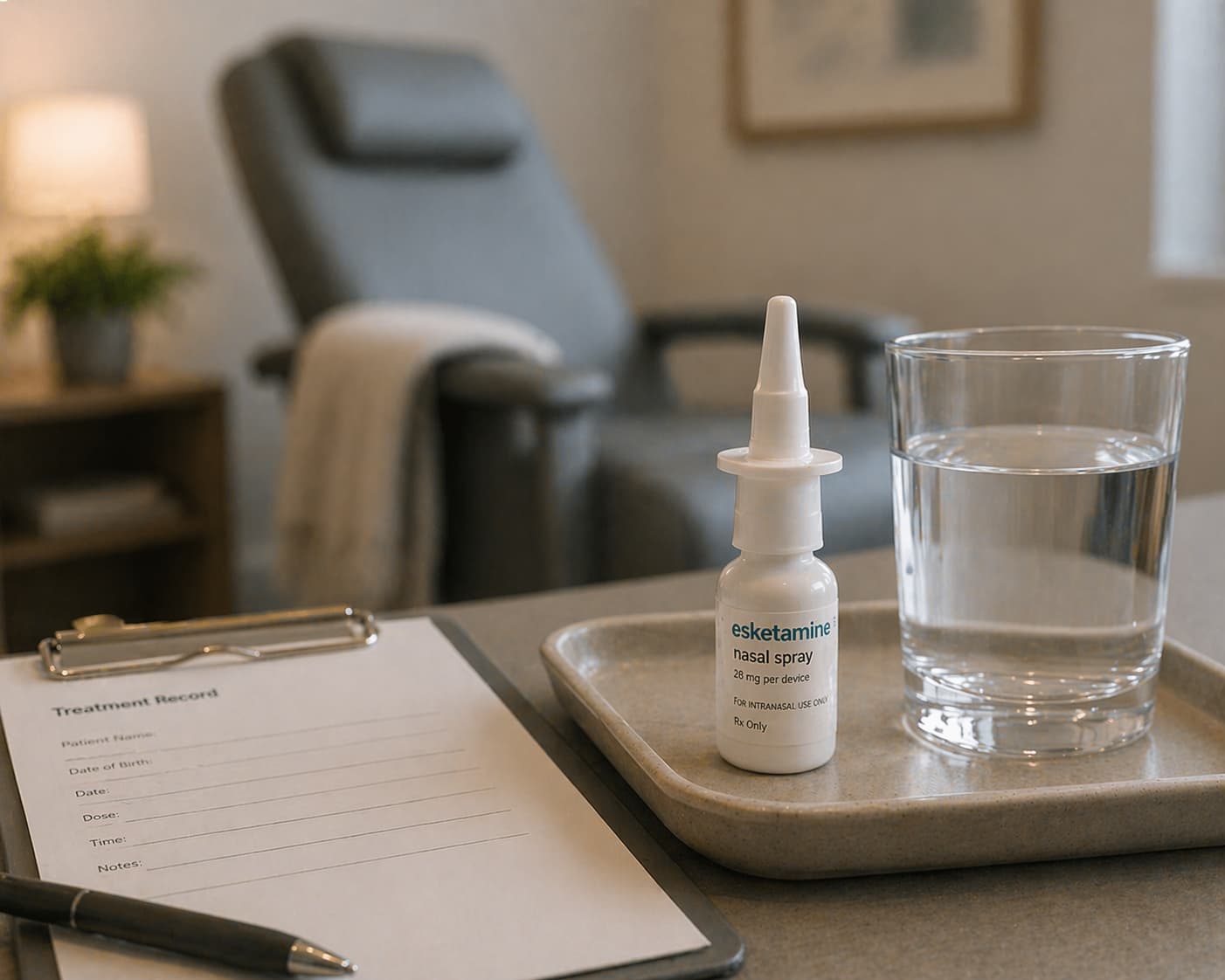
Esketamine is a fast-acting, clinic-based treatment for depression that may help when other options haven’t worked. Delivered as a supervised nasal spray, it works differently from traditional medications and can provide relief more quickly for some people.

Examples of ketamine therapy side effects are dissociation, nausea, and fatigue, but these are usually short-lived and manageable in a clinical setting. With proper supervision and aftercare, treatment can be both safe and effective.

Ketamine for depression is an emerging treatment that can provide rapid relief, especially when other options haven’t worked. By targeting different brain pathways, it offers a new approach to care and is used under medical supervision as part of a personalized treatment plan.

Spravato treatment (esketamine) is a clinic-based treatment for treatment-resistant depression that works differently from traditional antidepressants by targeting the brain’s glutamate system and supporting neuroplasticity. It’s administered as a nasal spray under medical supervision.